Even Professional Readers Need a List
In 2018, four years after having left my tenured faculty position in English and fled the East Coast for the West, I was constantly nudged by a just-beneath-the-surface-of-consciousness thought: I wasn’t reading enough. Reading has always been constitutive for me. It’s woven deeply into my childhood: “go read a book” was my very protective and very busy single mother’s sole answer to requests ranging from playing outside to relieving boredom to being too hot in the summer. Reading and re-reading carried me through adolescence and into college, where I discovered that reading could actually be a profession. By the time I was teaching college classes, I estimate that I was reading something like 50 novels a year for my courses, not counting what I was reading for pleasure.
And then I found myself in a new job, in a new city, having dragged 73 boxes of books across the country to a tiny Mid-City apartment. Maybe I was busy rebuilding my life? Maybe the the thrill of urban living options distracted me? Maybe it was the internet? (Side note: let’s not underestimate the time-suck of the internet.) So my unexpressed anxiety about reading less—less often and lesser amounts—bided its time, waiting for an opportunity to assert its rightful place in my habits and priorities.
Thankfully, a colleague of mine, a life-long learner in the best sense, happened share with me her semi-obsessive practice of logging her extensive reading list each year. I felt a rockslide of disbelief and envy and admiration, and it gave my reading anxiety something to climb, a set of pitons to scramble up and make some demands. I’ve never been terribly motivated by quantitative measures, but this seemed like an experiment worth trying.
2022 marks Year Five of making a list, and setting some quantitative goals. In the first couple of years, I learned that the emphasis on quantity could limit my choices (e.g., I weighed heavily the consequences of reading something like Moby Dick, which I knew would take me weeks, and diminish the annual tally). But I also learned to make good choices about when I was more likely to move through a longer book with focus and attention, and to schedule my choices wisely. And most importantly, the practice of the making the list, and knowing that it’s there, reminds me that reading is a priority, that it deserves attention. The presence of the list asserts itself when I’ve been away from a book for too long.
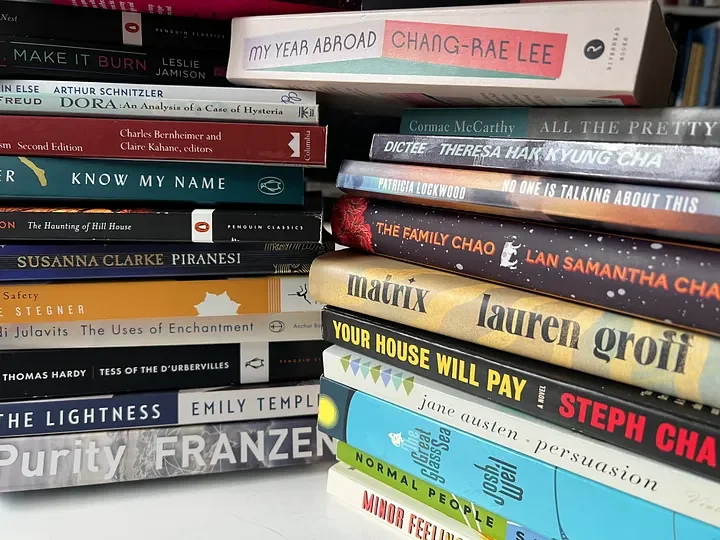
I’m looking forward to Year Six of the practice. In the meantime, here’s my 2022 list. I’m noticing lots of Asian American writers here, both the well-established (Chang-rae Lee, Ishiguro, Cha) and some newer voices (Zauner, Steph Cha, Pek, among others). This was also the year that I found Shirley Jackson, and I don’t know what took me so long. I think I’ve only got one of her novels left to read in 2023 — I’ll save her completely enthralling, creeptastic psychological prose for a special occasion where I can devote my whole focus to it.
Other hot takes: Chanel Miller’s memoir is a miraculous read for her ability to articulate her pain, to identify societal and institutional assumptions and practices that cause them, and ascribe her resistance to her family and her artistic practice. I’m excited to see what she does next. I saved Susanna Clarke’s newest novel until I had some free time, and I’m so glad that I did. Her ability to ask hard questions about what’s real, and the strength of belief in imagination, is as powerful here in this slim volume as it was in Jonathan Strange and Mr. Norrell. Steph Cha’s novel is such a smart and complex wrestling with the causes and outcomes leading up to the LA uprising, for both Korean and Black families and communities. I would teach this book in a heartbeat. Emily Temple’s book is a delicious romp, which ignited all of my Heathers nostalgia — it’s one hell of a first noel. I’m not sorry that I read that Thomas Hardy novel, but JEEEEZ it’s a gut punch. (Note to self: when a horse gets impaled in the first 50 pages, you should know you’re in for a tough ride, like slowly and continually using a cheese grater on your arm.) Finally: all Joan Didion is wonderful, but Joan Didion on California is a masterclass in how to synthesize history, ecology, economics, and national myth-making to tell your own origin story.
Crying at H Mart, Michelle Zauner
Paul Takes the Form of a Mortal Girl, Andrea Lawlor
We Have Always Lived in the Castle, Shirley Jackson
Make It Scream, Make It Burn, Leslie Jamison
The Sun Dial, Shirley Jackson
Signs Preceding the End of the World, Yuri Herrera
The Verifiers, Jane Pek
My Year Abroad, Chang-rae Lee
Klara and the Sun, Kazuo Ishiguro
The Mineral Palace, Heidi Julavits
Know My Name, Chanel Miller
Dora: An Analysis of a Case of Hysteria, Sigmund Freud
In Dora’s Case: Freud — Hysteria — Feminism, ed. Bernheimer and Kahane
Fraulein Else, Arthur Schnitzler
The Uses of Enchantment, Heidi Julavits
Dictee, Theresa Cha
No One Is Talking About This, Patricia Lockwood
All the Pretty Horses, Cormac McCarthy
The Family Chao, Lan Samantha Chang
Hellblazer: Original Sins, Jamie Delano
The Great Glass Sea, Josh Weil
Persuasion, Jane Austen
Your House Will Pay, Steph Cha
The Great Offshore Grounds, Vanessa Veselka
Matrix, Lauren Groff
Norwegian Wood, Haruki Murakami
Piranesi, Susanna Clarke
The Haunting of Hill House, Shirley Jackson
Minor Feelings: An Asian American Reckoning, Cathy Park Hong
Crossing to Safety, Wallace Stegner
Normal People, Sally Rooney
Axiom’s End, Lindsay Ellis
Tess of D’Urbervilles, Thomas Hardy
The Lightness, Emily Temple
You Were Born for This, Chani Nicolas
Purity, Jonathan Franzen
Where I Was From, Joan Didion